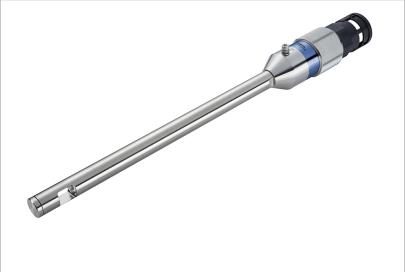
Measurement principles
How the light meets your sample
Every Hellma probe sends light into the process and returns it to the spectrometer. What differs is the path the light takes.
Tidus probes
Raman
How it works
- Laser light travels down the probe. A beam splitter turns it onto the optical axis and it is focused on the sample.
- Almost all of the scattered light comes back at the laser wavelength. A tiny fraction is shifted by the molecules' vibrations: the Raman signal.
- The Raman light returns along the same path (direct backscatter). It passes the beam splitter, and a filter removes what is left of the laser line before the collection fiber.
Advantages
- Exchangeable optics and filters.
- Optics optimized for maximum Raman signal.
- A large measuring spot focused on the sample from several centimeters away.