Why single use
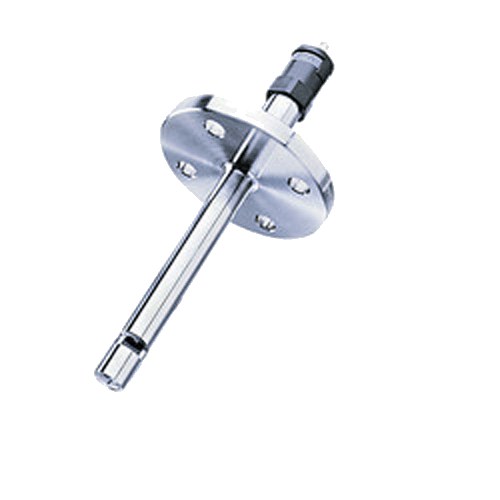
Biopharmaceuticals such as monoclonal antibodies are made in single-use bioreactors of up to 2,000 liters and purified in single-use tubing sets. Inline UV sensors watch each purification step without manual samples, so the sensor parts that touch the product have to be disposable too.
The challenge
Existing single-use UV sensors fell short on dead volume, price-performance and ecological footprint. The quartz part needed a 1 mm (0.04 in) gap held to within 0.05 mm (0.002 in), parallel windows of high optical quality and a seal to the plastic body around it, at a cost that suits a disposable part.
Quartz cold casting
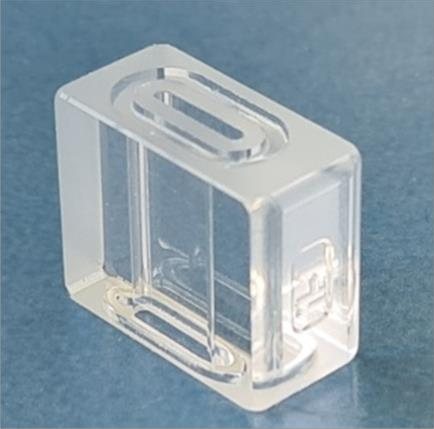
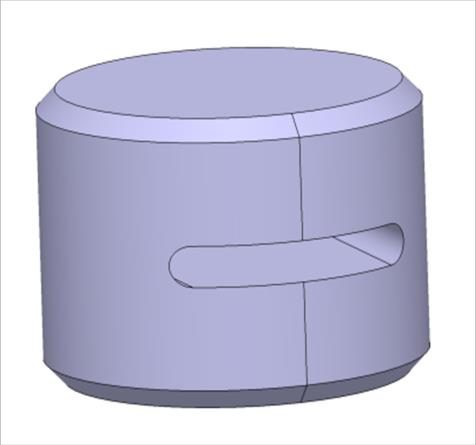
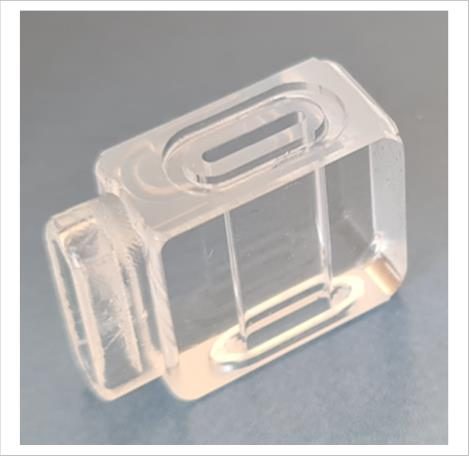
Hellma's Quartz Cold Casting (QCC) pours a silicon-containing compound into molds at room temperature, cures it and converts it to pure quartz glass. The flow cell comes out monolithic, in one piece, with sealing structures molded in, so many conventional processing steps disappear.
Into series production
The project began with a feasibility study after the Sartorius PAT team saw QCC at ACHEMA. Hellma refines, inspects every gap width, packages and qualifies the cells under the PPAP process, so they go straight into the Sartorius sensor.
The payoff
Every connection size has the same, precisely known optical path length. That lets spectroscopic methods, not just simple photometry, determine concentration, with minimal dead volume and practically no effect on flow.
“As part of the good cooperation with Hellma, we succeeded in jointly iteratively developing an optical sensor core component from the first draft to series production under the highest quality requirements.”
Dr. Christian Grimm, Head of Product Development Embedded Hardware, Sartorius Stedim Biotech GmbH